
Welcome
Welcome to Module: Life Cycle Assessment Principles.
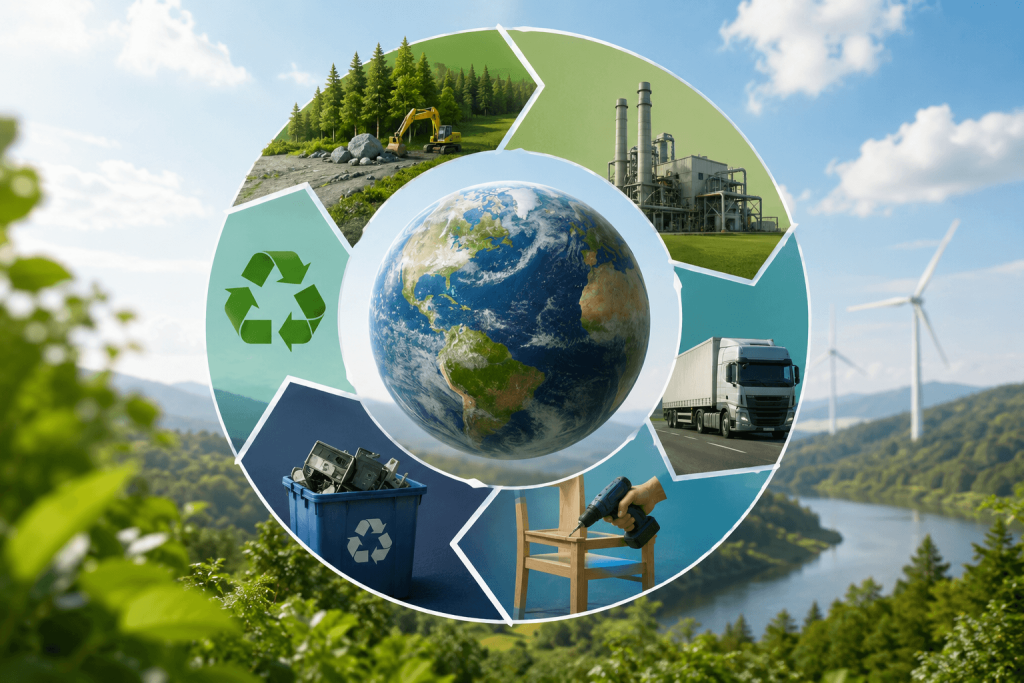
Life Cycle Assessment (LCA) has become one of the most widely used methods for evaluating the environmental performance of products, services, and organisations. However, sustainability requires more than environmental thinking. Throughout this course, you will also explore Life Cycle Costing (LCC), Social Life Cycle Assessment (S-LCA), and Life Cycle Sustainability Assessment (LCSA).
By completing this module, you will learn how sustainability assessments are designed, conducted, interpreted, and applied to support evidence-based decision-making.
Course Learning Outcomes
After successfully completing this course, you will be able to:
✅ explain the principles of Life Cycle Assessment (LCA);
✅ distinguish between LCA, LCC, and S-LCA;
✅ apply the ISO 14040 and ISO 14044 framework;
✅ construct a basic Life Cycle Inventory (LCI);
✅ interpret environmental, economic, and social assessment results;
✅ identify sustainability hotspots and trade-offs;
✅ evaluate uncertainty and sensitivity in sustainability assessments;
✅ use basic LCA tools and databases;
✅ apply life cycle thinking to Circular Economy and Industrial Symbiosis;
✅ prepare a simplified sustainability assessment for a real product or service.
Course Structure
The course consists of 10 self-paced lessons.
| Theme | Estimated Time | |
|---|---|---|
| 1 | Introduction to Sustainability, Circular Economy and Industrial Symbiosis | 90 min |
| 2 | Introduction to LCA, LCC and S-LCA | 90 min |
| 3 | ISO 14040 and ISO 14044 Frameworks | 90 min |
| 4 | Building and Managing Life Cycle Inventory (LCI) Data | 120 min |
| 5 | Life Cycle Impact Assessment (LCIA) Methods and Indicators | 90 min |
| 6 | Environmental, Economic and Social Assessment | 90 min |
| 7 | Sustainability Interpretation and Decision Support | 90 min |
| 8 | Digital Tools and Databases for LCA | 120 min |
| 9 | LCA Applications in Circular Economy and Industrial Symbiosis | 120 min |
Learning Approach
This course has been designed for independent, self-paced learning.
Each lesson follows the same structure:
📖 Introduction
🎥 Presentation and learning materials
📚 Reading
💡 Interactive activities
🧩 H5P exercises
📝 Knowledge check quiz
📄 Assignment (selected lessons)
How to Complete the Course
To successfully complete the course, you should:
- Review the lesson presentation.
- Read the recommended learning materials.
- Complete all H5P interactive activities.
- Pass the lesson quiz with at least 80%.
- Where applicable, complete the required assignments (will be assessed maually by the instructor).
All lessons must be completed to earn the course certificate.
Assessment Overview
| Assessment Activity | Purpose | Requied to Pass the Course and Earn Certificate |
|---|---|---|
| Interactive Activities | Practice and self-assessment | No |
| Lesson Quizzes | Knowledge verification | Yes |
| Written Assignments | Application of concepts | Yes |
Estimated Workload
| Activity | Estimated Time |
|---|---|
| Study of learning materials | 8 hours |
| H5P activities | 2 hours |
| Lesson quizzes | 1.5 hours |
| Assignments | 3.5 hours |
Total workload: approximately 15 hours (equivalent to approximately 0.5 ECTS credit).
Software and Resources
During the course you may use:
- Microsoft Excel (recommended)
- OpenLCA (optional)
- Footprint Calculator (optional)
- Online LCA databases (introduced later in the course)
No specialised software is required for successful course completion.
Tips for Success
✔ Complete lessons in the recommended order.
✔ Take notes while reviewing presentations.
✔ Complete the H5P activities before attempting the quiz.
✔ Use the assignments to apply concepts to real-life situations.
✔ Reflect on sustainability trade-offs rather than looking for a single “correct” answer.
