
What is discrimination?
Discrimination is a manifestation of behaviour based on prejudice. According to Allport (1954), it is directly directed against members of other groups to whom we have prejudices; this is a difference in treatment that manifests itself in “preventing access of vulnerable groups to some common goods, for example, unequal opportunities for schooling, employment, in the crushing of their civil liberties and rights at the disposal of the dominant group “(Ule, 2004).
There are many types of discrimination, such as according to gender, pay, age, etc. In the following, we present discrimination on the grounds of nationality, race, and religion:
National origin discrimination involves treating people (applicants or employees) unfavourably because they are from a particular country or other parts of the world, because of ethnicity or accent, or because they appear to be of specific ethnic background (even if they are not). National origin discrimination also can involve treating people unfavourably because they are married to (or associated with) a person of a particular national origin. Discrimination can also occur when the victim and the person who inflicted the discrimination are of the same national origin.
Race discrimination involves treating someone (an applicant or employee) unfavourably because he/she is of a specific race or because of personal characteristics associated with race (such as hair texture, skin colour, or specific facial features). Colour discrimination involves treating someone unfavourably because of skin colour. Race/colour discrimination also can involve treating someone unfavourably because the person is married to (or associated with) a person of a particular race or colour. Discrimination can also occur when the victim and the person who inflicted the discrimination are the same race or colour.
Religious discrimination involves treating a person unfavourably because of his or her religious beliefs. The law protects not only people who belong to traditional, organised religions, such as Buddhism, Christianity, Hinduism, Islam, and Judaism but also others who have sincerely held religious, ethical or moral beliefs. Religious discrimination can also involve treating someone differently because that person is married to (or associated with) an individual of a particular religion.
What are the examples of discriminatory practices and manifestations of discrimination?
A beautiful illustration of the functioning of prejudices and structural discrimination is the term “Roma issue”. This has been established, especially in the media, but it should not be understood as a hint of the problem of the Roma, let alone its synonym. It is. This can not be avoided, even though those who use it usually do not want to do anything wrong with it and only describe the social conditions in which the problem of the situation of this ethnic community and the various responses to it are perceived. As the Ombudsman of the Republic of Slovenia (2008) points out, the use of this term often shows the problems of coexistence, originating from open prejudices and even hostile attitudes towards the Roma. Therefore, he should be avoided. Instead of the term “Roma issues”, a more neutral term “Roma topic” may be used.
In the case of people with disabilities, the most common way is their obstruction, but not their abilities and abilities. Unfortunately, this is not an unusual story of a person with a university education in an economic direction who did not receive an invitation for a single interview for a job (despite more than 100 notifications), probably because he had been honestly stated in the applications that he was blind. We live in the age of informatics! In some countries such as Slovenia even have a quota system for the employment of disabled people, which directs employers with more than 20 employees to employ disabled people as well. More than half of such employers in Slovenia prefer to pay compensation to the Employment Fund for Disabled Persons as if they were recruiting a disabled person and finding incentives for them, for example, enabling the purchase of the braille line. Are they left to stereotype and prejudice about the disabled? Does it smell of discriminatory practices?
Example: (Religious and Political Belief): Jože, 69 years old still remembers the horrible guilt at school: Although he always knew the right answer to all questions of the teacher, he ever got a worse rating than Cene, even when Cene did not know anything. The teacher hated Jože because every Sunday he was ministering in the local church, but Cene was the head of the local youth organisation.
Example (race, skin colour): because of the darker skin colour, you are not served at the local hospital. You are treated as an alleged Roma or an African immigrant.
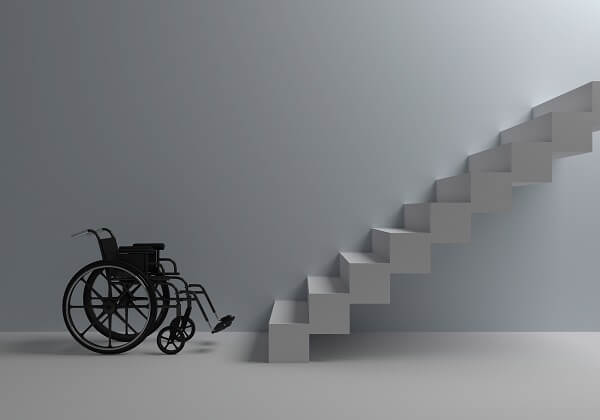
Example (disability): also children with special needs (children on a trolley) may be affected by the inaccessibility of the school (stairs), because they are denied access to the nearest school too, and they may need to enrol the child in a neighbouring school (causing additional inconvenience, costs and steals time.)
Example (race, ethnic origin): The mayor of a municipality declares that the Roma are undesirable in it and that they should be prevented from selling the land.
Example (Ethnic Origin and Citizenship): From candidates for the job of a cook, a goalkeeper, or in a similar position, the management of a public institution requires a certificate of schooling in Slovenia and a certificate of excellent oral and written knowledge of the Slovenian language.
Example (age): The health insurance institute does not give the braille line to a person who is blind (needed for a computer) because it had already received a braille typewriter 15 years ago and that it has exhausted its right to a technical device. Since such powers were exercised by older people who master Braille (a font for the blind), they are disproportionately worse treated as younger blind persons (who, for example, have no interest in choosing a braille typewriter – it only allows writing texts, but not reading and information).
Example (sexual orientation): In the workplace, Metka is often exposed to offensive remarks and e-mails by colleagues because of her daughter who is a lesbian and is a well-known activist for rights of same-sex orientation. Although she has repeatedly appealed against such harassment, her complaints have been rejected, since she is not a lesbian herself.
Example (age): a lady (54 years old) failed to file an appeal to the employer for the suspicion of age discrimination since the employer did not send her to any education during the entire year. The employer then explained to her that she “only causes problems”, began to impose excessive work tasks, but did not enable her promotion. Similarly was happening to a co-worker who testified to her benefit.
Example (disability): A blind person is prevented from entering the café with a dog guide because it is prohibited for animals.
Example (disability): A company that employs new people has an HR department located on the 3rd floor, which does not lead to an elevator. An applicant on a wheelchair entering the interview for a job is allowed to have the meeting on the ground floor where he/she can more easily come.
Example (disability): The fire alarm must be not only an audible but also a visual warning since deaf and poor hearing workers will be able to recognise and take it into account
Example (gender and age): The advertisement that only younger women are employed in the shop means discrimination on the grounds of sex and age at the same time.
Example (illness): A nursery assistant in the kindergarten was fired because he was perceived as annoying. He was the only male co-worker (and he resisted, for example, the constant use of a female grammatical form, for example, in his employment contract ) because he was union-active (which had adverse consequences for the female teachers) and because he was mentally ill or had individual psychological disorders (which was why he was considered not to be able ta handle the children). If these attributes or reasons were not coincidental, he would not lose his job.
Whaat are not the examples of discriminatory practices and manifestations of discrimination?
Example (gender): The Customs Administration seeks solely female candidates in a call for recruitment of persons who will carry out personal checks at the airport. This criterion excludes men. In the concrete case, there are already six men employed for such work at the airport, so the requirement for women is justified, as men cannot correctly investigate female passengers. Apparently, there is no violation (direct discrimination on the grounds of sex).
Example (race): For Bruce Lee’s role in the feature film, he is looking for a player of Asian origin.
Example (age, education): A citizen of the Republic of Slovenia, who is a legal expert and is at least 40 years old, can be elected a judge of the Constitutional Court. Even though the provision excludes people under the age of 40, such an employment requirement is permitted, since the objective is legitimate and requires a proportionate one. The request is related to the life experience that a candidate for the post of a Constitutional Judge must have. However, there is no dilemma about the justified need for the highest level of professional competence (no direct discrimination on the grounds of age or education).
Example (religious belief): For employment in religious communities or organizations founded by them and based on the ethos of those organizations (e.g. schools and kindergartens), it is permissible to require that this religious belief is an essential and decisive condition for employment (which naturally excludes anyone who does not have it and those who may have a different view). This is specially permitted by Article 3 of the Religious Freedom Act (not direct discrimination on the grounds of religious conviction). Of course, such an exception does not allow the perception that, for example, based on sexual orientation (for example, to fire a teacher who is genuinely gay, that is, this means denying religious conviction), because this is another, independent personal circumstance. Gays can also have such religious beliefs.
