
Definition of social responsibility
We make a living by what we get, but we make a life by what we give.” – Winston Churchill.
Being Socially Responsible means that individuals and organisations must behave ethically and with sensitivity toward social, cultural, economic and environmental issues. Striving for social responsibility helps individuals, institutions and governments have a positive impact on development, business, and society with a positive contribution to bottom-line results.
Individual Social Responsibility (ISR) to achieve Corporate Social Responsibility (CSP)
ISP may appear to be a new concept about CSP, but it is a concept as old as The Golden Rule – Do unto others as you would have them do unto you. ISR expands on this by promoting a proactive stance towards positively influencing and affecting the people and environments outside your immediate circle. ISR is at the roots of CSR because it is comprised of individuals and hence determines the social responsibility culture it creates. This is the intermingled relationship between CSR and ISR. Individuals are becoming more socially responsible and, in response to these Corporations and Companies need to grow more socially accountable for meeting consumer demand.
The International Organisation for Standardisation (ISO) states: “In the wake of increasing globalisation, we have become increasingly conscious not only of what we buy but also how the goods and services we buy have been produced. Environmentally harmful production, child labour, dangerous working environments, and other inhumane conditions are examples of issues being brought into the open. All companies and organisations aiming at long-term profitability and credibility are starting to realise that they must act by norms of right and wrong.”
Socially responsible individuals are demanding companies and organisations to become more socially responsible.
How Does an Individual Become Socially Responsible?

The Workshop for Civic Initiatives Foundation (WCIF), Bulgaria, describes ISR in its position statement on Social Responsibility as, “The individual social responsibility includes the engagement of each person towards the community where he lives, which can be expressed as an interest towards what’s happening in the community, as well as in the active participation in the solving of some of the local problems. Under community, we understand the village, the small town or the residential complex in the big city, where lives every one of us. Each community lives its own life that undergoes a process of development all the time. And every one of us could take part in that development in different ways, for example by taking part in cleaning of the street on which he lives, by taking part in the organisation of an event, connected with the history of the town or the village or by rendering social services to children without parents or elderly people. Individual social responsibility could also be expressed in making donations for significant social causes – social, cultural or ecological. There are many ways of donating, as donating goods or donating money through a bank account or online.”
Social Responsibility can be “negative,” in that it is a responsibility to refrain from acting (resistance stance) or it can be “positive,” meaning there is a responsibility to act (proactive stance). Being socially responsible not only requires participating in socially responsible activities like recycling, volunteering and mentoring but actually making it a lifestyle. Only through a commitment to embrace and embed social responsibility into your value and belief system can you genuinely become socially responsible in all you do.
According to The Harris Poll ® #57, June 18, 2007[7], when it comes to individual social responsibility, there are three types of people:
- Two-thirds of adults have “Good Intentions” – they believe that social responsibility is a good idea, and they do what they can regarding volunteering, but they do not sacrifice vast amounts of time or money.
- At the top end of the spectrum, 8 per cent adults “Practice What They Preach” and for this group, individual, as well as corporate, social responsibility is critical.
- One-quarter of adults, however, follow a philosophy of “To Thine Own Self Be True” and, for this group, social responsibility has little consequence in their lives.
On the other hand, the trends show that the most significant growth for prominent charitable organisations in the world is coming from individuals and not from Corporations and Governments.
To take a proactive stance, ISR can start as a simple act of altruistic behaviour. My husband and I budget for donating, just like we do for living or car expenses. Add to this the campaigner, volunteer, and activist in you that picks up and supports issues affecting society. You may start off volunteering once a month somewhere that suits your skills, abilities or interests. The other day, I asked a friend if he could teach my son guitar. We determined a tuition cost, but instead of me paying him, he asked me if I could spend for the charity of his choice. If you have the option of two products and one product supports a good cause or was produced more ethically, then purchase that product. You may only be one person, but if everyone did their part, we could change the world!
All Social responsibility, both individual and corporate, is voluntary; it is about going above and beyond what is called for by the law(legal responsibility). It involves an idea that it is better to be proactive toward a problem rather than reactive to a problem. Social responsibility means eliminating corrupt, irresponsible or unethical behaviour that might bring harm to the community, its people, or the environment before the behaviour happens.
Social Responsibility Quotes:
- “I think that my life belongs to the whole community, and as long as I live, it is my privilege to do it whatever I can. I want to be thoroughly used up when I die, for the harder I work, the more I live.” ~George Bernard Shaw
- “The impersonal hand of government can never replace the helping hand of a neighbour.” ~Hubert H. Humphrey
- “One is a member of a country, a profession, a civilisation, a religion. One is not just a man.” ~Antoine de Saint-Exupéry, Wartime Writings 1939-1944, translated from French by Norah Purcell
- “Each of us is a being in himself, and a being in society, each of us needs to understand himself and understand others, take care of others and be taken care of himself.” ~Haniel Long
- “We cannot always build the future for our youth, but we can build our youth for the future.” ~Franklin Delano Roosevelt
- “Every individual has a place to fill in the world and is important in some respect whether he chooses to be so or not. ~Nathaniel Hawthorne
- “Independence”… [is] middle-class blasphemy. We are all dependent on one another, every soul of us on earth.” ~G.B. Shaw, Pygmalion, 1912
- “A machine has value only as it produces more than it consumes – so check your value to the community.” ~Martin H. Fischer
- “A man is called selfish not for pursuing his good, but for neglecting his neighbour’s.” ~Richard Whately
- “We cannot live only for ourselves. A thousand fibres connect us with our fellow men.” ~Herman Melville
Definition of ethics
A definition of ethics regarding standards such as rights and fairness By Manuel Velasquez, Claire Andre, Thomas Shanks, S.J., and Michael J. Meyer
Some years ago, sociologist Raymond Baumhart asked business people, “What does ethics mean to you?” Among their replies were the following:
- “Ethics has to do with what my feelings tell me is right or wrong.”
- “Ethics has to do with my religious beliefs.”
- “Being ethical is doing what the law requires.”
- “Ethics consists of the standards of behaviour our society accepts.”
- “I don’t know what the word means.”
These replies might be typical of our own. The meaning of “ethics” is hard to pin down, and the views many people have about ethics are shaky.

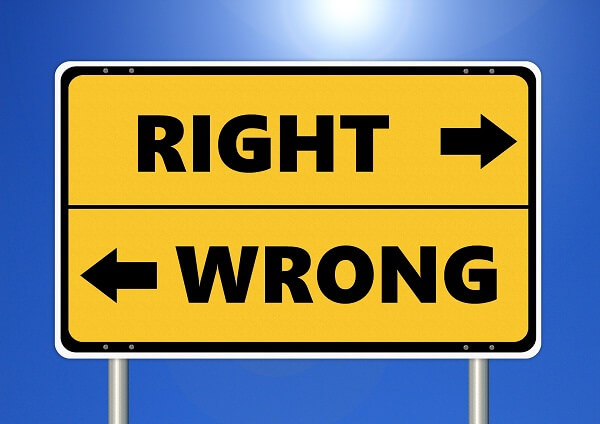
Like Baumhart’s first respondent, many people tend to equate ethics with their feelings. But being ethical is not a matter of following one’s beliefs. A person following his or her feelings may recoil from doing what is right. Emotions frequently deviate from what is ethical.
Nor should one identify ethics with religion. Most religions, of course, advocate high ethical standards. If ethics were confined to religion, then ethics would apply only to religious people. But ethics refers as much to the behaviour of the atheist as to that of the devout religious person. Religion can set high ethical standards and can provide powerful motivations for ethical conduct. Ethics, however, cannot be confined to religion, nor is it the same as religion.
Being ethical is also not the same as following the law. The law often incorporates ethical standards to which most citizens subscribe. But rules, like feelings, can deviate from what is ethical. Pre-Civil War slavery laws in South Africa and the old apartheid laws of present-days are grotesquely obvious examples of regulations that differ from what is ethical.
Finally, being ethical is not the same as doing “whatever society accepts.” In any society, most people accept standards that are, in fact, ethical. But standards of behaviour in a community can deviate from what is ethical. An entire society can become ethically corrupt. Nazi Germany is an excellent example of a morally corrupt society.
Moreover, if being ethical were doing “whatever society accepts,” then to find out what is ethical, one would have to find out what society accepts. To decide what I should think about abortion, for example, I would have to take a survey of American society and then change my beliefs to whatever society accepts. But no one ever tries to decide an ethical issue by doing a study. Further, the lack of social consensus on many issues makes it impossible to equate ethics with whatever society accepts. Some people allow abortion, but many others do not. If being ethical were doing whatever the community allows, one would have to find an agreement on issues which does not exist.
What, then, is ethics? Ethics are two things. First, ethics refers to well-founded standards of right and wrong that prescribe what humans ought to do, usually regarding rights, obligations, benefits to society, fairness, or specific virtues. Ethics, for example, refers to those standards that impose reasonable obligations to refrain from rape, stealing, murder, assault, slander, and fraud. Ethical standards also include those that enjoin virtues of honesty, compassion, and loyalty. And, ethical standards include rules relating to rights, such as the right to life, the right to freedom from injury, and the right to privacy. Such measures are adequate standards of ethics because logical and well-founded reasons support them. Secondly, ethics refers to the study and development of one’s ethical standards. As mentioned above, feelings, laws, and social norms can deviate from what is ethical. So it is necessary to continuously examine one’s standards to ensure that they are reasonable and well-founded. Ethics also means, then, the continuous effort of studying our own moral beliefs and our ethical conduct and striving to ensure that we, and the institutions we help to shape, live up to standards that are reasonable and solidly based.
