Introduction
Plastics are everywhere in our daily lives. Their production has grown exponentially worldwide over the past two decades, except during the recent pandemic period. Under the EU Green Deal (EGD), 55% of plastic packaging must be recycled by 2030 to reduce not only its ecological footprint but also its social and economic consequences.
This requires innovative design, cleaner production, and recyclability initiatives built on the principles of a circular and climate-neutral economy.
The present course is designed to equip learners with the knowledge, skills, and tools needed to understand plastic and packaging composition and management — from collection to end of life — with a focus on the potential for second life through innovative solutions and responsible behaviour.
Welcome to “Education for Plastic in a Circular and Climate-Neutral Economy – Preventing Waste from Ending Up in the Environment.” Here, plastic and packaging will be seen from a new perspective: not as pollutants of our ecosystems, but as materials to be managed in a smart, sustainable, and climate-responsible way.
Before we continue, we invite you to check your current level of understanding in the subject area of this course. After completing the course, you can take the self-assessment again to see how much you’ve improved.
Now, let’s work together to close the loop on plastic and packaging.

Target group
The main target group of the course is adult lifelong learners from EU countries (aged 18–65), specifically:
- Managers and employees of different organizations (particularly those who may collaborate with HEIs), who will apply the knowledge acquired from the course to make their organizations and processes greener with regard to plastics.
- HEI teachers/educators (all categories of teaching staff), who will transfer the knowledge gained from the course to their students.
- Students from various engineering education programs, including learners at different levels (BSc, MSc, PhD), who will be better prepared to address and face future plastic/packaging challenges.
General aim of the course
The purpose is to develop and strengthen the green skills of HEI teachers and students, managers, and employees, as well as to promote green practices related to plastic and packaging. Moreover, the course contributes to fostering responsible behaviour across the EU.
It aims to prepare proactive individuals who can contribute to the discussion and implementation of sustainable and climate-neutral plastic and packaging management at local, national, and global levels.
Course-specific objectives
At the end of the course, learners will be able to:
- Improve their behaviour through increased awareness, participation, and responsibility in issues related to plastic use and management.
- Follow the lifecycle of plastic and packaging products — from production to end-of-life — and understand their environmental impact.
- Identify and apply best practices for plastic and packaging within the circular and climate-neutral economy.
- Understand global and local policies and regulations related to plastic and packaging management in the context of a circular and climate-neutral economy, and know how to comply with them.
- Analyze the relationship between plastic and packaging management and climate change.
- Apply the knowledge and skills gained to explore and develop advanced solutions in the future.
Badges and Certificate
As you progress through the Edu4PlastiCircular – Educating for Sustainable Plastic Use and Circular Economy course, you can follow a learning path that recognises your achievements through a series of digital badges:
🔍 PlastiCircular Explorer – awarded for completing Topics 1–4 of Module 1, Topics 1–2 of Module 2, and Topic 1 of Module 3.
🛠️ PlastiCircular Practitioner – awarded for completing Module 2, Module 3, and the first two topics of Module 4, demonstrating your ability to apply circular economy principles in practice.
🎯 PlastiCircular Strategist – awarded for completing Module 4 and Module 5, recognising your capacity to develop strategic approaches to plastic circularity.
🏆 PlastiCircular Champion – the final achievement in the learning path, awarded to learners who complete all modules and topics of the Edu4PlastiCircular course. PlastiCircular Champions also receive a validated course certificate acknowledging their comprehensive knowledge and commitment to sustainable plastic use and the circular economy.
Begin your journey as an Explorer, advance to Practitioner, grow into a Strategist, and ultimately become a PlastiCircular Champion. Upon reaching the PlastiCircular Champion level, you will also earn a certificate.
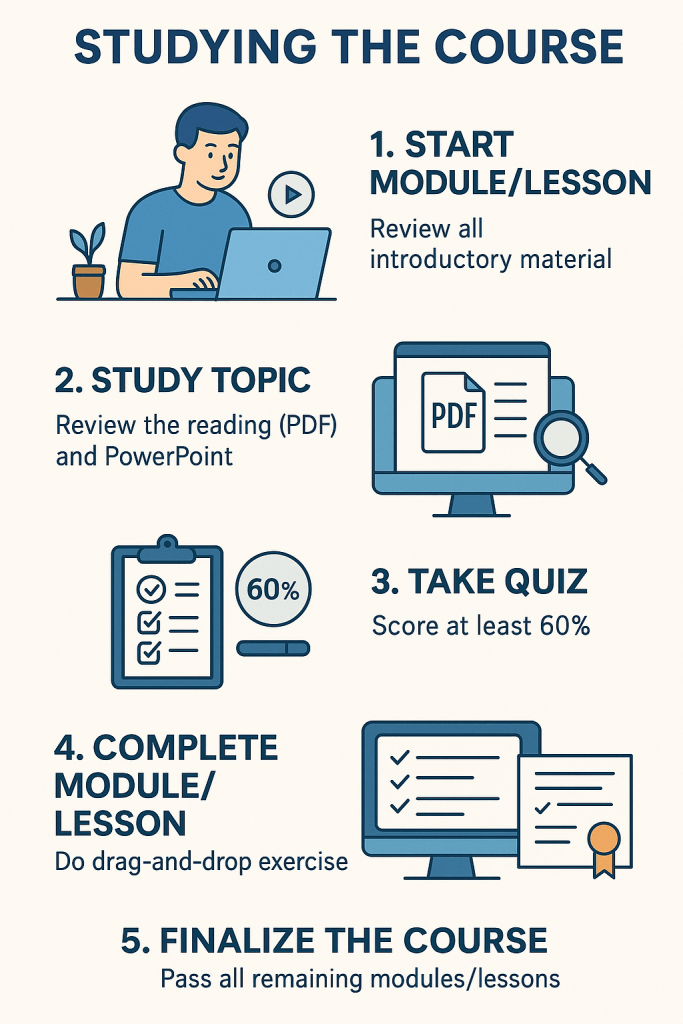
Smart Study Tips