

About this course
Welcome to the transformative journey of becoming a role model and future teacher in the Makerspace!
This is Course 4 of Module 2 in a series of 9 courses, carefully curated for role models/teachers within the scope of the EU-funded project Challenger. All courses in this program are designed and developed by professionals from Vocational Education and Training (VET) providers.
This module is designed to provide you with the essential knowledge and skills to navigate the dynamic landscape of applied research in Vocational Education and Training (VET). By engaging in this comprehensive exploration, you will be equipped to foster innovation and entrepreneurial mindsets among your students.
Module outline:
By the end of these modules, you will have acquired valuable insights and skills and be prepared to guide and inspire future innovators in the makerspace. Let’s embark on this journey towards a future of innovation, sustainability, and transformative change together!
This course is offered for free. Upon registration and passing the multiple-choice tests at the end of each course, you will receive a confirmation of participation in the form of a digital badge. After completing all courses in the module, you will receive an innovation certificate proving your experience and gained know-how.
Get ready to engage in an enriching educational experience that will expand your horizons and empower you to become a competent and impactful role model in the makerspace. Let’s embark on this journey together towards a future of innovation, sustainability, and transformative change.
Empower Your Teaching with Maker-Centric Learning
Unlock the full potential of your students with challenge-based learning. Transform your classroom into a hub of innovation and creativity. Equip yourself with forward-looking approaches to facilitate consistent student advancement.
Welcome to “Creativity and Problem-Solving in Action,” a comprehensive course designed for educators keen on incorporating maker culture into their teaching. This course will guide you through setting up a makerspace, crafting engaging challenges, and fostering an environment that priorities student-driven learning.
In this journey, you’ll explore:
The Philosophy of Makerspaces: Understanding the core principles that make makerspaces a powerful learning environment.
Designing Challenges: How to create and implement effective challenge-based learning experiences that inspire creativity and problem-solving. When designing challenges, aligning them with the challenge-based approach is essential, ensuring that they present authentic problems that inspire creativity and critical thinking among students.
Facilitating Maker Projects: Tips and strategies for guiding students through their projects, from ideation to completion. As educators facilitate maker projects, they play a pivotal role in guiding students through the challenge-based learning process, encouraging them to tackle real-world problems with innovative solutions.
Assessment in Maker Education: Innovative approaches to evaluating student progress in a makerspace setting. Assessment practices in maker education should be tailored to reflect the challenge-based approach, recognising not only the final outcomes but also the process of problem-solving and iteration that students engage in.
Introduction
The aim is not to completely redefine the school system, but like every living organism, school systems must evolve to meet the demands of the 21st century. Makerspaces in schools symbolise this evolution, providing environments where students engage in hands-on, problem-solving learning experiences. Integrating makerspaces doesn’t necessarily require new physical spaces. If space is limited, consider repurposing a section of an existing classroom. Makerspaces are dynamic environments where problem-solving is not just encouraged but woven into the fabric of learning. To dismiss the need for makerspaces in our schools is to overlook the fundamental shifts in our educational landscape. In an era where information is ubiquitous, schools must transition from mere sources of knowledge to hubs where students learn to navigate information critically and collaboratively.
Makerspaces embody this shift, offering spaces where theoretical knowledge meets practical application under mentorship. However, evolving our educational systems to include makerspaces is challenging. It requires commitment, creativity, and a willingness to experiment and learn from both successes and setbacks. As Charles Darwin observed, all living things must evolve over time to avoid extinction. Makerspaces are about providing the tools and space for creation and fostering a mindset of innovation, resilience, and collaboration. They can be as simple as a corner with a few resources or as complex as a fully equipped workshop, depending on the school’s capabilities and resources.
The key is to start with what you have and grow from there. Educational research and case studies have shown that makerspaces can significantly enhance student engagement, creativity, and problem-solving skills. Becoming a beacon of light and learning in your students’ lives means embracing the role of a maker-space mentor. It’s about guiding them through the process of inquiry, experimentation, and discovery. You don’t have to overhaul your entire classroom or curriculum overnight. Begin with small, manageable projects that encourage creative problem-solving and build from there.
Embrace the challenge of becoming a maker-space mentor and lead your students into a future where they are not just consumers of information but creators and innovators.
Challenged-based learning
Challenge-based learning empowers students to apply their knowledge and skills to real-world problems, cultivating a sense of purpose and engagement in their learning journey. By presenting challenges that mimic authentic scenarios, educators inspire students to think critically, collaborate effectively, and innovate solutions. These challenges serve as catalysts for creativity, igniting students’ curiosity and driving them to explore multiple perspectives and approaches. Through the challenge-based approach, students not only acquire subject-specific knowledge but also develop essential 21st-century skills, such as problem-solving, communication, and adaptability.
Encouraging a Creative Mindset
To create an environment that sparks creativity and experimentation among students, teachers can adopt the following strategies:
- Promote a Risk-Taking Culture: Encourage students to take risks by emphasising that failure is a valuable part of the learning process. Celebrate attempts and iterations as much as successes, fostering an atmosphere where students feel safe to experiment and fail.
- Provide inspirational Examples: Share stories of innovators, artists, and scientists who have made significant breakthroughs by thinking differently. Highlighting real-world applications of creativity instills inspiration and shows students the impact of creative thinking.
- Diversify Resources and Tools: Equip the makerspace with a wide range of materials and technologies. Exposure to diverse tools and resources sparks students’ imagination and enables them to experiment with various mediums and techniques. – Allocate Time for Exploration: Dedicate time for students to explore their interests without specific objectives. This unstructured time encourages curiosity-driven learning and the discovery of new passions.
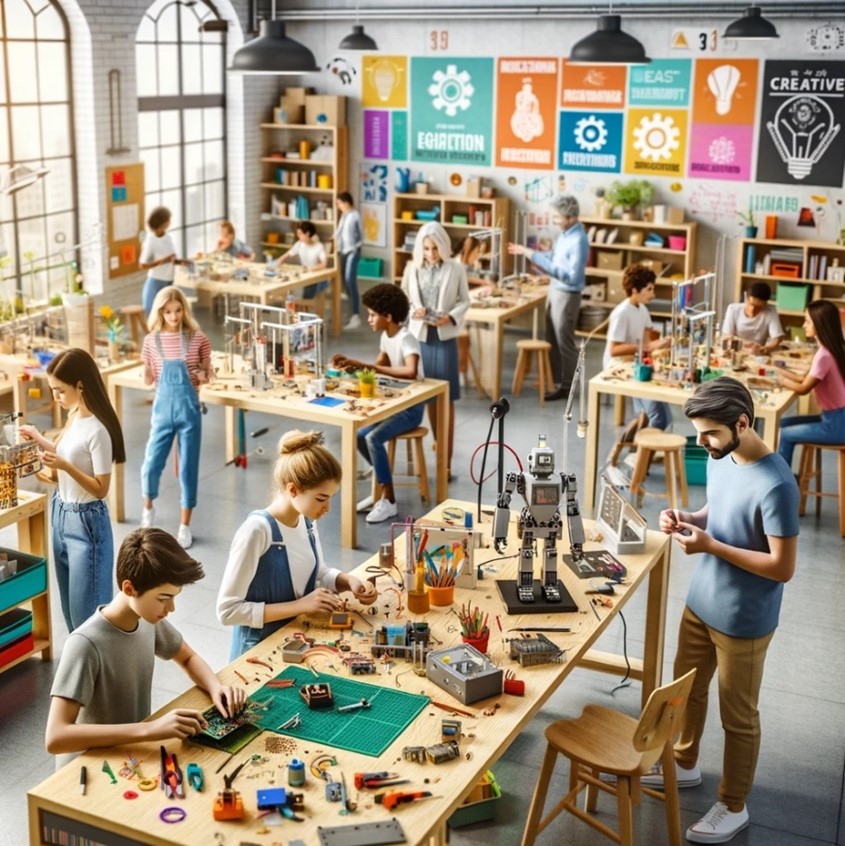
As educators facilitate maker projects, they serve as mentors, guiding students through the challenge-based learning process. By providing scaffolding and support, educators empower students to navigate through the complexities of real-world problems and develop innovative solutions. Through iterative cycles of ideation, prototyping, and testing, students learn to embrace failure as a natural part of the problem-solving process and persist in finding viable solutions. Educators play a crucial role in fostering a supportive environment where students feel encouraged to take risks, explore new ideas, and collaborate with their peers. By integrating the challenge-based approach into maker projects, educators equip students with the skills and mindset needed to thrive in an ever-changing world.
Problem-Solving Techniques
Incorporating structured problem-solving techniques can significantly enhance the effectiveness of makerspace projects. It is important to realise that nothing happens at once and that success is achievable only through steps/phases. There are three impactful methods that you can use on this journey:
1. Design Thinking: A human-centred approach to innovation that integrates the needs of people, the possibilities of technology, and the requirements for business success. It involves five phases: Empathise, Define, Ideate, Prototype, and Test. This iterative process encourages students to develop empathy, define problems clearly, brainstorm innovative solutions, prototype, and refine their ideas based on feedback.
2. The SCAMPER Method: This technique involves seven strategies for thinking creatively about existing products or problems:
- Substitute: What can be replaced to improve the product?
- Combine: Can we combine elements to create something new?
- Adapt: How can we alter this to serve another purpose?
- Modify: What can be modified to create a change?
- Put to another use: How can we use this in another way?
- Eliminate: What can be removed without sacrificing functionality?
- Reverse: Can we reverse or rearrange elements for benefit?
SCAMPER facilitates a structured exploration of possibilities, encouraging students to think outside the box.
3. Brainstorming and Mind Mapping: These collaborative thinking activities encourage the free flow of ideas and help visualise thought processes. Brainstorming generates a wide range of ideas, while mind mapping helps organise and connect these ideas visually, aiding in problem definition and solution brainstorming.
Example of using Problem Solving Techniques on a School project
An innovative Urban Beekeeping Project has unfolded, led by the curiosity and ingenuity of students immersed in the world of design thinking in the heart of one of the school’s makerspaces. This project exemplifies the power of structured problem-solving and design thinking in creating meaningful, impactful learning experiences. Students tackled pressing environmental issues, contributing to biodiversity preservation and community engagement, all within the creative confines of their school’s makerspace. The project lasted one school year, involving 47 students and 5 teachers, and was done using problem solving techniques within 4 Phases:
Phase 1: Empathise and Define with Design Thinking
Objective: Understand the importance of bees and identify urban beekeeping challenges.
Activity: 47 students from different educational fields (economics and constructions) collaborated in this project. They conducted interviews with local beekeepers and the president of beekeeping association of Slovenia, local farmers, and biologists to learn about the role of bees in pollination and the challenges they face, such as habitat loss and pesticides.
A lecture about the role of bees in urban and rural land was conducted for the students. They explored how urban environments can support bee populations and the benefits of beekeeping to local ecosystems and human communities.
Outcome: The core problem was defined as the decline of bee populations in urban areas and a lack of awareness about the importance of bees to biodiversity and food production.
Phase 2: Ideate with Design Thinking and Brainstorming
Objective: Generate innovative solutions for urban beekeeping and education.
Activity: In brainstorming sessions, students came up with ideas for creating bee-friendly spaces in the school and the community. The students worked in the school’s computer classrooms, where they worked on the idea using the Torch method. Ideas included the school’s own apiary, beekeeping club, and educational workshops for students and community members.
Outcome: A rich collection of potential solutions focusing on habitat creation, education, and community engagement.
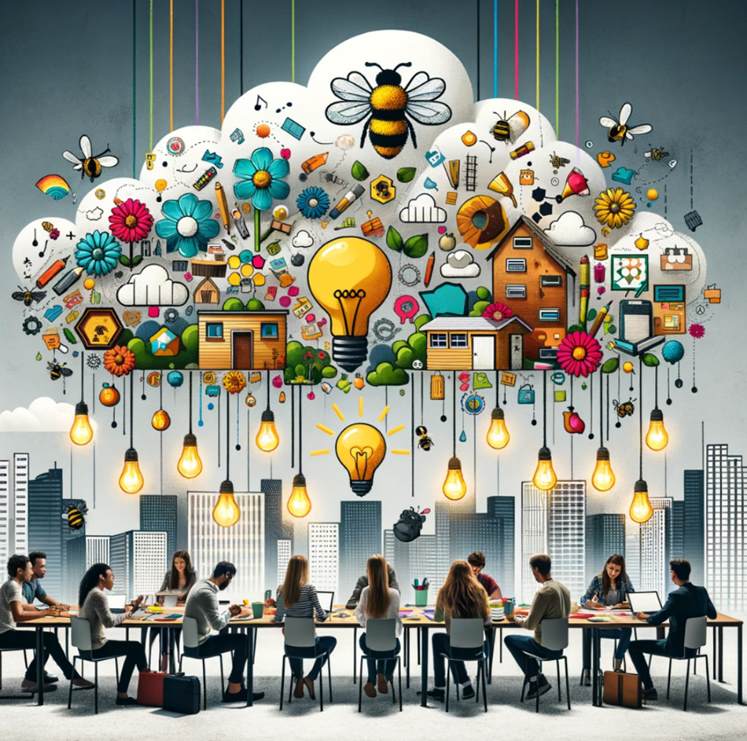
Phase 3: Prototype with Design Thinking and SCAMPER methods
Objective: Develop prototypes for urban beekeeping initiatives using SCAMPER for creativity.
Activity:
- Substitute: Usage of school park for bee habitats instead of traditional rural locations.
- Combine: Pairing beekeeping with a curriculum on environmental science.
- Adapt: Modifying existing gardening projects to include bee-friendly plants and flowers.
- Modify: The change of the design of apiary to fit urban aesthetics and safety standards.
- Put to another use: Utilise honey produced by the school bees for promotional usage and fundraising activities.
- Eliminate: They identified and reduced the use of pesticides in school grounds and nearby areas.
- Reverse: Implementation of a “Bee Ambassador” program where students educate the community about beekeeping benefits.
Outcome: Prototype of the designs for bee habitats, educational programs, and community engagement strategies.
Phase 4: Test with Design Thinking and Mind Mapping
Objective: Test the prototypes and refine based on feedback.
Activity: Students of construction educational field draw various apiaries with computer program AutoCAD. 7 plans of school apiary were then shown to the local beekeeper, who then chose the apiary that was most suitable. The students of construction educational field made a list of material needed to make the apiary and then gave it to students of economical educational field, who then made a financial plan of the school apiary and made an online questionary for other students about the purpose of urban beekeeping. Their assignment was also to create a beekeeping club that would (with a local beekeeper) conduct workshops for other students and the community.
Outcome: An optimized urban beekeeping project that enhances biodiversity, provides educational opportunities, and engages the community in sustainability practices.
Implementation and Continuous Improvement
With the guidance of teachers and beekeeping experts, the project seamlessly integrates into the school’s environmental curriculum, becoming a beacon of innovation within the makerspace. Continuous monitoring, learning, and adaptation ensure the project’s growth and success, embodying the essence of real-world problem-solving and learning. This project exemplifies the power of structured problem-solving and design thinking in creating meaningful, impactful learning experiences. Students tackle pressing environmental issues, contributing to biodiversity preservation and community engagement, all within the creative confines of their school’s makerspace.
Assessment and Feedback
In makerspaces, the approach to assessment and feedback is pivotal in nurturing creativity and problem-solving abilities. It’s important that this evaluation method not only focuses on the result but also gives due importance to the creative process and the skills developed along the way. Adopting a process-oriented assessment framework involves crafting rubrics that assess creativity, effort, problem-solving, and teamwork, alongside the tangible outcomes. This strategy acknowledges the significance of the journey towards the solution, promoting the acquisition of essential skills.
Feedback should be precise, practical, and geared towards fostering improvement. By pinpointing specific strengths and identifying areas for growth, educators can guide students to perceive feedback as an integral part of their educational journey, one that is instrumental in their development.
Additionally, integrating peer review into the learning process can greatly enhance students’ critical thinking and communication abilities. This form of assessment enables learners to gain insights from their peers’ viewpoints and methodologies, creating a rich, collaborative learning atmosphere that benefits all participants.
Course materials
ADDITIONAL MATERIAL / LINKS
Maker Education Initiative (www.makered.org): A wealth of resources for educators looking to incorporate making into their curriculum.
Instructables (www.instructables.com): A community where people can share and discover DIY projects and how-to guides.
Thingiverse (www.thingiverse.com): Offers a vast collection of free 3D printing models that can be used for educational projects.
Fab Foundation (www.fabfoundation.org): Provides information on setting up fab labs and makerspaces, including tools, curricula, and operational strategies.
Assignment
Design a challenge for your future or existing makerspace that incorporates elements of creative problem-solving and innovation. This challenge should be achievable within 2-3 class periods and require students to use at least one tool or technology available in your makerspace. One out of three problem-salving methods mentioned in the course should be used during the class periods (Design Thinking, SCAMPER method, Brainstorming and Mind-mapping). Outline the objectives, required materials and a brief rubric for assessing the outcomes. If a makerspace doesn’t exist in your school, or if the existing one is not appropriate, you can draw one out and describe everything it should include.

Funded by the European Union. Views and opinions expressed are however those of the author(s) only and do not necessarily reflect those of the European Union or the European Education and Culture Executive Agency (EACEA). Neither the European Union nor EACEA can be held responsible for them.
